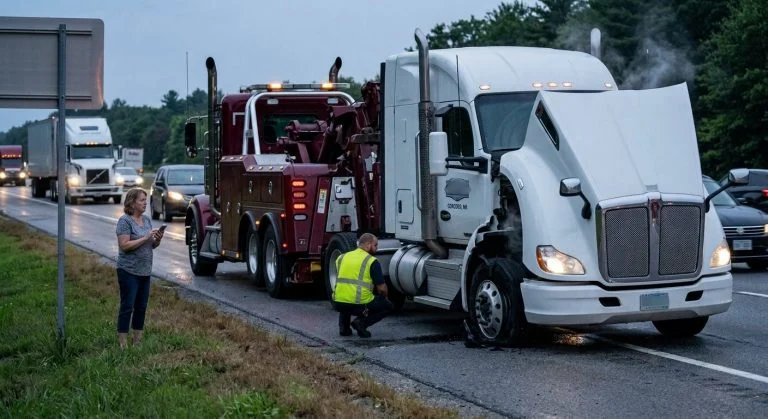
Why Construction Companies in Concord, NH Need a Dedicated Heavy-Duty Towing Partner on Speed Dial
Construction doesn’t stop because a machine breaks down. Deadlines don’t move because a dump truck is stuck axle-deep in mud on a job site. When heavy equipment goes down mid-project, every hour it sits idle costs real money: in delayed labor, missed milestones, and equipment rental fees that keep running whether the machine is working or not.
Most construction companies have a plan for everything on the job site. Subcontractors, material deliveries, inspections, permits, all of it scheduled and coordinated. But the one thing many operations don’t have locked in before they need it is a dedicated heavy-duty towing and recovery partner. That gap only becomes obvious at the worst possible moment: when a piece of equipment is down, blocking other work, and nobody knows who to call.
Here’s why having that relationship established before an emergency happens is one of the smartest operational decisions a construction company in the Concord area can make.
Job Site Recoveries Are a Completely Different Challenge From Highway Towing
When most people think of towing, they picture a disabled vehicle on a road: paved surface, clear access, relatively straightforward hookup. Job site recoveries are almost never that simple.
Construction sites present a combination of terrain and access challenges that standard towing equipment simply isn’t built for. Soft ground, gravel, mud, uneven surfaces, narrow site access roads, and active work zones all change the complexity of a recovery significantly. A standard tow truck that works perfectly on a highway shoulder may not be able to get close enough to a disabled piece of equipment to do anything useful, and if it does get close, it may not have the rigging capacity to move something the size of a loaded dump truck or an excavator.
Beyond terrain, the types of equipment involved on construction sites are themselves more varied and complex than standard road vehicles. Dump trucks, concrete mixers, excavators, bulldozers, cranes, compactors, and skid steers all have different weights, configurations, and recovery points. Moving one safely requires knowing where those points are and using equipment rated for the specific load, not improvising with whatever happens to be available.
The Real Cost of Getting the Recovery Wrong
A mismatched recovery on a job site doesn’t just waste time. It can cause damage that’s far more expensive than the original breakdown.
Pulling a stuck dump truck from the wrong angle with underrated equipment can warp the frame, damage axles, or dig the vehicle in deeper rather than out. Attempting to move an excavator without the right trailer or lifting equipment risks structural damage to components that are expensive and slow to replace. And any recovery attempt that fails on a job site means the equipment sits disabled even longer while the right help is arranged, extending the downtime that’s already costing money by the hour.
Getting the recovery right the first time, with equipment matched to the actual load and operators who understand job site terrain, is almost always cheaper than dealing with the aftermath of a failed first attempt.
Common Job Site Recoveries
- Dump trucks stuck in soft ground or mud
- Loaders, excavators and skid steers that break down on site
- Trucks that slide off a temporary road or ramp
- Equipment that needs to move between job sites
- Work trucks with dead batteries or flat tires
Mud Season in New Hampshire
Spring is the hardest time of year for job sites around Concord. As frost leaves the ground, dirt roads and sites turn soft, and a loaded dump truck that drove in fine in the morning can sink to the axles by the afternoon. Planning helps: keep heavy trucks on firm ground where you can, use mats where you can’t, and call for a recovery before a stuck truck digs itself in deeper.
Moving Equipment That Can’t Be Driven
When a loader, excavator or forklift breaks down, it can’t drive onto a trailer. Our Landoll trailer tilts down to the ground, so the machine can be winched on carefully and carried to the shop or the next job site, without bringing a crane to the site.
What to Tell Us When You Call
- The job site address and how to get in: gate, access road and a site contact
- The machine or truck: make, model and weight if you know it
- How it’s stuck, or what broke
- The ground conditions: mud, sand, a slope or a soft shoulder
- Where it needs to go
Set Up Before the Next Project
Save our number, (603) 696-4734, with your foremen and equipment managers before the next project starts. Knowing who to call, and having the details ready, turns a stuck truck into a short delay instead of a lost day.
Planning Recoveries on Tight Sites
Job sites rarely have room for a big recovery. Trenches, stockpiles, other equipment and overhead lines all limit where a wrecker can set up. A rotator helps here, because its boom turns and can work from the side or at an angle instead of straight behind the stuck vehicle.
Keep Your Crew Safe
- Keep workers well away from any cable or strap under tension
- Don’t let anyone stand between the recovery truck and the stuck vehicle
- Shut down the stuck machine unless our operator asks you to run it
- Mark trenches and soft spots so the recovery truck stays on firm ground
- Have one site contact talk with our operator
Winter Job Sites
Winter brings frozen ruts, icy ramps and snow-covered edges that hide soft spots. Trucks slide off temporary roads, and cold mornings bring dead batteries and gelled diesel in equipment that sat overnight. We handle those calls too, from jump starts to full recoveries.
Moving Between Sites
Sometimes a machine isn’t broken; it just needs to be somewhere else. Our Landoll trailer can move equipment between job sites or to the shop for service.
Paperwork for the Insurance
If a truck or machine was damaged, take photos before it’s moved, note the time and conditions, and keep the towing details. Your insurance company will ask for them, and having them ready speeds up the claim.
Local Knowledge Helps
We work around Concord every day, so we know the roads in and out of the city, from I-93 and I-89 to I-393 and US-4, and how to reach job sites in Bow, Pembroke, Hooksett and Boscawen. That means less time finding the site and more time getting your truck out.
Frequently Asked Questions
Can you recover a truck that slid off a temporary road?
Yes. Tell us how far it slid, whether it’s leaning and what’s under it, so we can plan a safe pull.
Can you move a skid steer or mini excavator?
Yes. Tell us the make and model, and we’ll bring the right trailer.
What if the truck is stuck near a trench or a slope?
Tell us when you call. We plan the recovery so the truck comes out without sliding further, and we keep our own truck on firm ground.
Can you recover a dump truck stuck on a job site?
Yes. Tell us the truck, the load and the ground conditions, so we bring equipment rated for the weight.
Do you work on job sites outside Concord?
Yes. We cover Concord and nearby towns, including Bow, Pembroke, Hooksett, Boscawen and Penacook.
Do you work on weekends?
Yes. We’re available 24 hours a day, 7 days a week.